If Ever You Would Leave Us
(we play for Rollins)
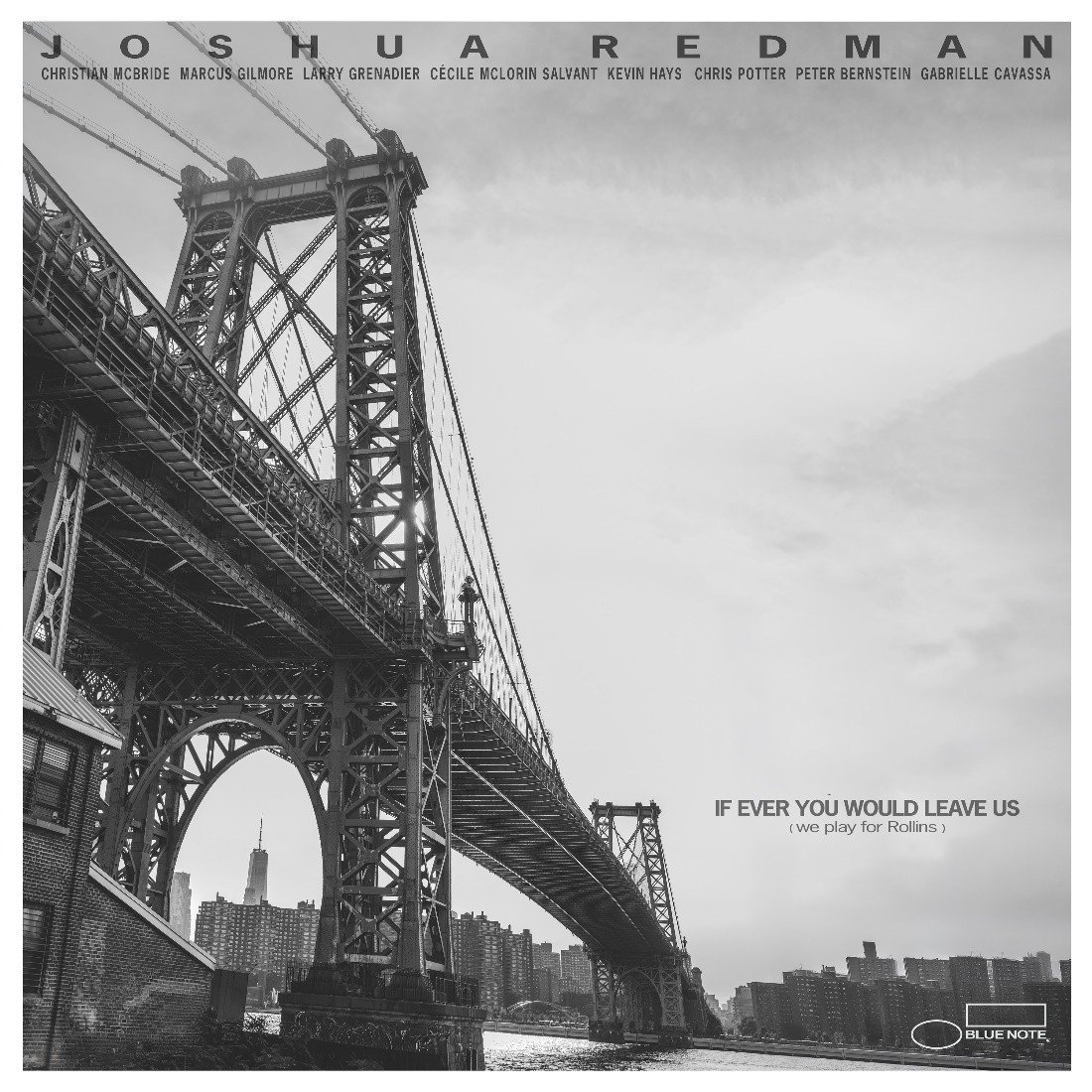
Release Date: November 20, 2026
-
The saxophonist Joshua Redman learned of Sonny Rollins’ death, on May 25, 2026, the same way so many of us did: by scrolling social media. He was at home in Berkeley, California, winding down after a joyful evening celebrating his daughter’s 16th birthday.
Redman, however, was moved far beyond Instagram to pay his respects. His new Blue Note album, If Ever You Would Leave Us (we play for Rollins), is a remarkable paean to the indelible impact of the Saxophone Colossus. It features 11 inspired selections from Rollins’ repertoire, originals and beloved standards alike, performed by a nonpareil group of musicians in a range of ingenious configurations — from solo saxophone to quintet, with a core of trio tracks featuring, in Rollins fashion, a piano-less trio of drummer Marcus Gilmore with either Christian McBride or Larry Grenadier on bass. Also helping Redman extol Sonny are veterans of Rollins’ band, including pianist Kevin Hays and guitarist Peter Bernstein, Redman’s fellow tenor virtuoso Chris Potter, and two of jazz’s finest vocalists, Cécile McLorin Salvant and Gabrielle Cavassa.
When Redman woke up on the day following Rollins’ passing — May 26, which also happened to be the day of Miles Davis’ centennial — he felt a cathartic need to do something for Sonny, but he didn’t quite know what. So he started making calls to friends and colleagues, and a loose coterie of great players readily made themselves available for studio sessions in New York that were assembled within a couple weeks. The programming discussions were deeply collaborative, and the studio sessions, Redman recalls, were “bustling, maybe even at times a touch hectic, but always super chill. Musical decisions were made quickly, collectively and organically.” The results coalesced into an LP that feels less like a funeral and more like an Irish wake. In every note, the sense of loss is palpable, but so are the joy and the gratitude.
“Sonny’s passing definitely hit me hard,” Redman says. “It felt not unlike the passing of a parent. He certainly felt like a musical father, grandfather and godfather, all rolled into one, for me and I think for all of us.”
“Us,” in this instance, could have the most expansive of definitions: saxophonists, sure, as well as jazz fans, musicians of any discipline, devotees of art and culture or simply human beings. Indeed, when The New York Times named Rollins a “Giant of the Jazz Saxophone” in his obituary headline, the paper both hit the nail on the head and undersold an American icon. In his classic recordings, his momentous performances and his uniquely introspective interviews, Rollins emerged as an avatar for the power of the human spirit.
It’s difficult to assess Redman’s career and not think of him in one way or another as one of Rollins’ most devoted and accomplished disciples. He is, after all, a prodigious saxophonist who continues to prove that jazz’s “golden age” is always upon us. He exists in a small, elite class of active musicians who can uphold all of modern jazz’s ideals in a single performance: the immaculately contoured improvisations; the room-filling sound, at once mellifluous and diamond-sharp; the gracefully confident bandleading; the impeccably balanced repertoire, which combines probing originals with arrangements of standards that honor both tradition and jazz’s ethic of personalization. It’s no wonder that Redman has long considered Rollins his “number one.” They also happen to share a penchant for relentless self-improvement that doesn’t abate with age.
“He’s my biggest influence as an improviser and as a saxophonist,” Redman says. “He was with us forever — for the totality of my life, and a lifetime before mine. He was somebody who felt like he would never leave us.” And, of course, thanks to Rollins’ abiding influence, he never will.
To trace Redman’s journey with Rollins’ music is to trace his trajectory as a musician. “I discovered Sonny Rollins right around the time I picked up the saxophone, at age 10 or 11,” he recalls. “I remember going to the Berkeley Public
Library and browsing through the bins, I saw this album, Saxophone Colossus. And I thought, ‘Hey, that’s a pretty bold title.’ [laughs] That was my eureka moment. I remember putting it on, and hearing Sonny made me understand: It awakened me to the true power and potential of jazz improvisation. When I discovered Sonny Rollins, that was my gateway, and my North Star.”
Many more favorite Sonny recordings followed, including Blue Note classics. Redman mentions Rollins’ first truly notable recording, for Bud Powell’s Blue Note debut, captured when the titan was still in his late teens. And of course he points to A Night At The Village Vanguard — “one of the, if not the, greatest live jazz albums ever recorded,” Redman testifies, adding, “It’s like the source code for the sax, bass and drums trio.” That record receives a subtle nod via a bittersweet “Softly, as in a Morning Sunrise” featuring Salvant. “When Cécile and I were talking about doing the song,” Redman says, “I asked her if she wanted to have piano or guitar. She said no, that it seemed more appropriate to do it with just bass and drums, for Sonny.”
The harmonically wide-open trio format has been a favorite challenge of Redman’s for many years — including on his 2007 Nonesuch release Back East, probably his most explicit Rollins homage until now. On the new album, the Redman/McBride/Gilmore trio unlocks “The Last Time I Saw Paris,” which Gilmore’s late grandfather, drum legend Roy Haynes, recorded with Sonny in 1957. The Redman trio plays the tune in 5/4 to the original’s 4/4, and other trio highlights explore that same strategy, making odd time feel fluid and swinging, as is Redman’s wont: “Pent-Up House” is “mostly” in 7; “Valse Hot” is “sort of” in 11. “It’s something my generation of jazz musicians embraced full throttle — being able to play naturally in odd time signatures,” Redman explains. “But I have to feel the rhythm in my body. It has to feel like dance music.”
Redman pares the personnel back further for duo takes of “Doxy,” with McBride, and a closing “Don’t Stop the Carnival,” with Gilmore (an opportunity, the saxophonist says, to honor Rollins’ calypso legacy without recording “St. Thomas” again). The LP opens with a solo rendition of “There Will Never Be Another You,” inspired by Rollins’ trio version captured live in Sweden in 1959 and circulated for years among collectors and musicians as a bootleg.
So much of If Ever feels like a chance to simply bask in peerless musicianship — just cue up the title track, with Hays on piano; or the original Rollins deep cut “Grand Street,” with Bernstein on guitar; or the take of “Blue Seven” where Redman and Potter engage in a tenor conversation that will no doubt be transcribed by countless aspirants the moment the album drops.
Other summits on the record are positively heartrending, such as their deeply expressive rendition of “God Bless The Child,” which Rollins famously recorded for his landmark 1962 “comeback” album, The Bridge. Here Redman and Co. decided to model their version on Rollins’ arrangement, adhering to his harmonizations and form with Cavassa handling the main melody while Redman supports. It’s a profound meta exercise in musical elegy, “a tribute to a tribute.” Just as Rollins lamented the passing of Billie Holiday, so do Redman and company offer a requiem for Sonny.
Redman met and spoke with the great man only a few times in his life, including once when he interviewed him for a JazzTimes cover story. On another occasion, in 1998, Joshua witnessed his father, Dewey Redman, the trailblazing saxophonist and colossal influence in his own right, have a very real conversation with Rollins about the complexities of aging.
It’s well known in jazz circles that Joshua was raised by his mother, Renee Shedroff; he estimates he saw his father at most 10 times between his birth and college. But when Joshua was 15, as he was becoming increasingly obsessed with the saxophone and the improvisational language of jazz, Renee recorded him and sent the tapes across the country to Dewey. Months passed, and then a phone call arrived. “You sound good,” Dewey said. “You sound like Sonny Rollins.”
-
There Will Never Be Another You
Doxy
The Last Time I Saw Paris
Pent-Up House
Softly, As In A Morning Sunshine
If Ever I Would Leave You
Blue Seven
Valse Hot
Grand Street
God Bless The Child
Don't Stop The Carnival
-
Joshua Redman - Saxophone
Christian McBride - Bass
Larry Grenadier - Bass
Marcus Gilmore - DrumsSpecial Guests:
Kevin Hays - Piano
Peter Bernstein - Guitar
Chris Potter - Saxophone
Cécile McLorin Salvant - Vocals
Gabrielle Cavassa - Vocals